Pixian Doubanjiang and Cream

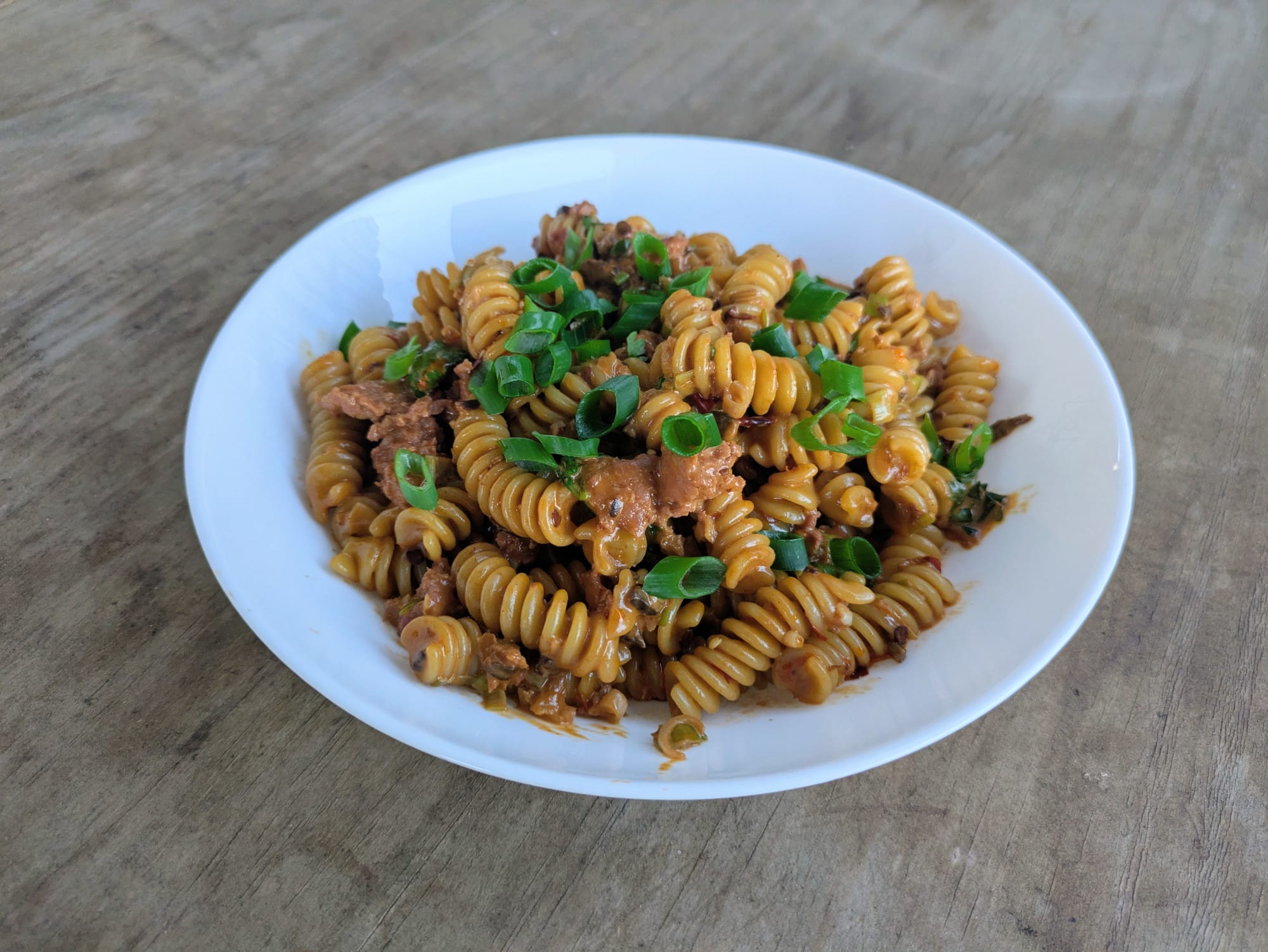
When experimenting again, I figured that flavours of Pixian doubanjiang and cream go pretty well together. Does anyone remember the hype of using gochujang or nduja in everything? I do. So why haven't we seen the same thing happen with doubanjiang?
One can only speculate. Gochujang is now even available in smaller supermarkets, and nduja might be findable in Italian speciality shops. Meanwhile, (the good) doubanjiang is not always available in Asian supermarkets, especially smaller ones. The more practical point is the salt content. Gochujang sits around 6-7% [1] and Nduja from 2-5% [2]. That makes them relatively versatile in cooking, while doubanjiang is in the 15-20% range [3]. This means if you want to use any significant amount, you need some some decent amount of starch with it and minimize the other salty ingredients in a recipe. There seems to be a decent body of research on reducing the salt content, but of course this changes the fermentation process and no chance that a salt reduced version will be in my local supermarket any time soon when the original is even hard to find.
Though this has not stopped me trying. So, without further ado, let's commit some culinary crimes together, shall we?
Doubanjiang & Fennel Pasta
When coming up with this dish, I thought pasta dishes with fennel sausage were more common in Italian cooking than they actually are. Between the first experiments and writing, I read Mythos Nationalgericht by Alberto Grandi. While its statements are a matter of debate in the broader Italian food history, the book prompted me to double-check.
After going down the rabbit hole, I found dishes using fennel and dishes using sausage that easily go back to the 1970s, but not the combination. For example, The Classic Book of Pasta (1985), a translation of Il codice della pasta (1973), mentions fennel only as a salami spice, and Marcella Hazan explicitly states in her The Classic Italian Cookbook (1973) not to use fennel sausage. A similar mention is made by Serious Eats article [4]. It seems to be more of a home cooking and Italian-American thing, as fennel sausage seems more the default there (though, funnily enough, even Aldi sometimes has it). In this rabbit hole, I also found a recipe from Ina Garten from 2016 [5] which essentially has the same idea. Furthermore, I'm not the first person to combine Doubanjiang, cream and pasta [6]. Even found a recipe by Nomante from 2024 [7] which is pretty close. While I have seen a decent amount of her content, I cannot remember ever seeing this recipe. Modern food content is essentially not searchable anymore, with much of it being on social media, hidden behind newsletters, or buried in search results by lots of random sites. An observation that has just solidified more since last year.
Matching fennel with Doubanjiang is not that unheard of, since fennel seeds are an ingredient in Chinese five spice. With all that in mind, this recipe sketch follows.
Ingredients
- Garlic (2 cloves, minced)
- Ginger (same amount as ginger, minced)
- Spring onion (around two 2, minced, green reserved)
- Pixian Doubanjiang (maybe a large tablespoon, minced into a paste)
- Cream (100g)
- Fusilli (~100g dried)
- One salsiccia (with fennel seeds, casing removed and crumbled into pieces)
- Oil
Steps
The recipe itself is rather simple. Bring a pot of water to the boil and add the pasta. Don't add salt, as the sauce will be salty enough. Next, mince the garlic, ginger, spring onions and Doubanjiang. Then, in a pan or pot with a little oil, fry the sausage until it starts to brown, then add the Doubanjiang. Use a lower heat as it burns quickly. After a few minutes, when the oil has turned red, add the garlic, ginger and spring onions. When they are soft, add the cream and reduce it a little. Once the pasta is almost al dente, add it to the mixture and finish cooking it. Once well combined, plate, and garnish with sliced green onions. And done!
One idea that probably no one else has tried before is combining it with Schmand or crème fraîche in Flammkuchen. After some initial experiments, it definitely works, essentially turning the liquid mapo tofu into something you can eat by the slice. Here again, the most critical part is getting the ratios right, as it gets too salty quick. Let's continue combining ingredients that traditionally never would meet, and use preparations with flavour profiles from different cuisines, and be amazed at what unexpected things work.
Online Sources
- https://kjhe.or.kr/_common/do.php?a=full&b=&bidx=1128&aidx=14610
- Table 2 https://real.mtak.hu/49886/1/aalim.2013.0006.pdf
- http://sf1970.cnif.cn/fileup/0253-990X/HTML/2020-13-230.shtml
- https://www.seriouseats.com/pasta-alla-norcina-creamy-pasta-with-sausage
- https://web.archive.org/web/20251217063511/https://archive.jamesbeard.org/recipes/rigatoni-with-sausage
- https://www.instagram.com/p/DXnjxQIjWnh/
- https://www.instagram.com/reels/C1zpo5Ytaub/